How a Consumer Insight Becomes a Brand
How a Consumer Insight Becomes a Brand
Pop, flip, catch, slide, revert, land.
Again.
Ollie to the sugar jar, boardslide on the table edge, kickflip off the napkin holder — flying across the room, crash landing on someone's MacBook. Hey, neighbour. Sorry about that.
Da Nang, Vietnam. One of those cafés that's half coworking space, half matcha temple. Waiting for my a-v-o-c-a-d-o toast with one hand flipping and the other doom scrolling through fashion posts on Instagram. People with noise-cancelling headphones deep in their Figma files, and me — the person whose fingerboard just hit your laptop. My ADHD and I have ruined a few deep work sessions across Southeast Asia. No apologies. Okay, some apologies.
And somewhere between a Japanese streetwear drop and the side-eyes of my coworking companions — earned, every single one of them — I got the idea for what you're about to read.
A brand case study. From one consumer insight to a full system.
You could skip sections. To avoid nonsense in the comments from people who only read half — I'd start from the top.
Find Coffee Beans: Consumer Insight
A consumer insight finds the gap between value and behaviour. "They spend real money on boards smaller than a credit card. Then crush them in their pockets like a receipt."
Grind the Beans: Purpose
Purpose is the one sentence a brand exists for beyond money. "To turn everyday carry into visible subculture." I wrote that. I broke it on three levels.
Heat the Water: Strategy
Vision, mission, goals, and the lines a brand refuses to cross. "Would someone clip this to their bag on purpose, in public? If no, it doesn't ship."
Brew the Coffee: Product
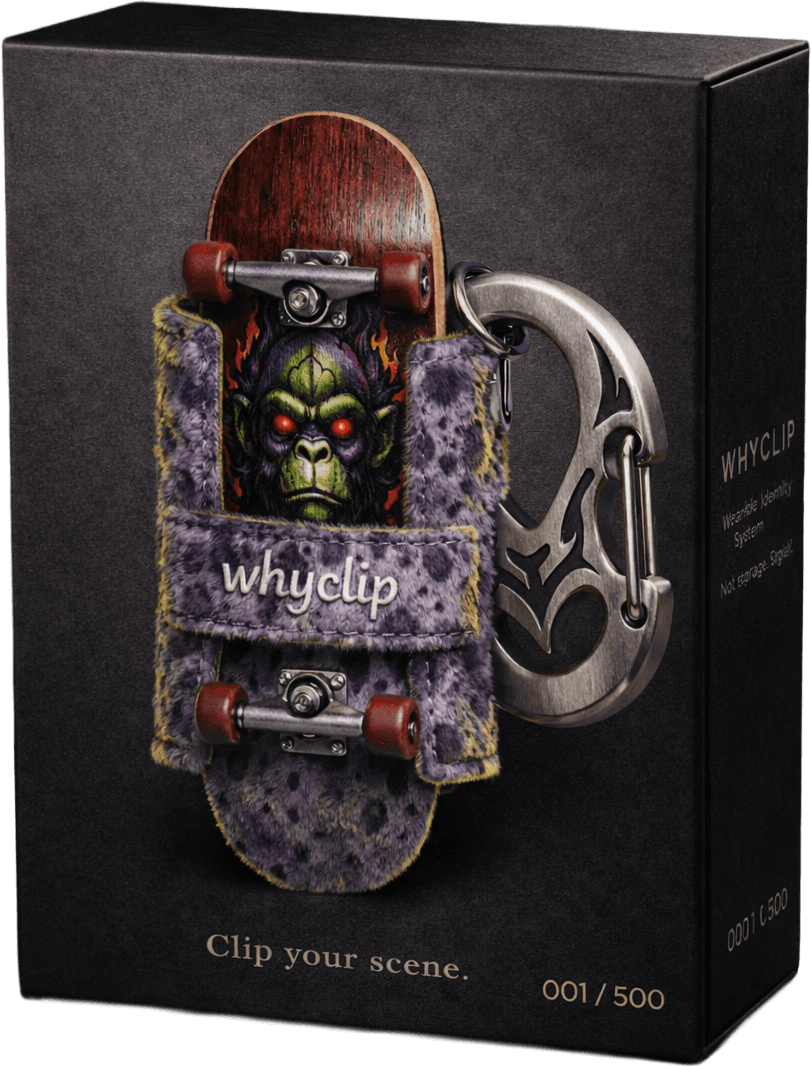
Every material choice reinforces or contradicts the brand. "Stainless steel carabiner — because weight changes perception."
Steep — let it sit: Packaging
Packaging design is pure manipulation for your nervous system. "Noradrenaline → acetylcholine → dopamine → oxytocin → serotonin. An unboxing, in the right order."
Press — push down slowly: Community Engine
The system that turns customers into players and players into recruiters. "001/500. Gaming dopamine. Buddy stickers. Skateparks. All of it built into cardboard."
Cup: Website
Every touchpoint translates purpose into experience. "A mascot that judges your deck choice silently. Copy that never says the word it's selling."
Sip: The Point
I didn't build this brand to sell fingerboard cases.
Find Coffee Beans: Consumer Insight
A fingerboard is an analogy for identity. The things you use the hardest — even when using them is what breaks them — can be the things you love most. On a psychology level, that goes deeper than you'd expect from a toy.
Visible vs. hidden
Skateboarders in the wild — grip tape out, graphic visible. Skate bags exist. Practical. But even in a bag — the shape gives it away. Same with other subclutures (musicians, runners, chess-lover etc.)People start reading you by what you carry – that’s again deep, but anyway.
Where does your board go when you leave the session? Pocket, bag, somewhere visible? Let me know in the comments if I’m wrong here.
Objects become identity
You're describing someone to a friend. "The one with the Rubik's cube." You didn't plan to define them by an object. But would you mention the constant solving — almost as annoying as the boards flying through the room? It would at least cross your mind, wouldn't it? An object that someone carries and interacts with continuously and publicly becomes part of how other people define them. That's identity.
Gap
Fingerboarders have the same relationship. They film tricks. They trade decks. They spend real money on boards smaller than a credit card and care about grip-tape texture the way watch collectors care about movements — that's the detail that separates inside from looking in. It matters to them.
And then they walk out and crush them in their pockets like a receipt.
Not because they don't care. Because nobody ever gave them a way to carry it the way they treat it.
The gap is the insight
In brand strategy, this gap has a name. A consumer insight — the conflict between what someone values and how they're forced to behave. And this one came down to a single line:
Hidden objects are utility. Visible objects are identity.
If you want to go deeper into consumer insights — how to find them, how to tell a real one from a guess — join my community. It's free. I answer questions directly, I'll go live and break down the process step by step.
Grind the Beans: Purpose
We've got the beans. You need something that grinds them into a form you can actually work with — and in brand strategy, that's purpose. The insight is raw material — substance you shape a bigger idea from (Rossa, 2024). The grinder here is a framework I built for turning an observation into a brand architecture. More about the framework in the community. For now — I'm showing you what it produces.
A self-commitment, not a slogan
A purpose is not a communicative promise — it is a commitment to what the brand exists for beyond revenue (Rossa, 2024). One sentence that answers why this thing exists — beyond making money.
To turn everyday carry into visible subculture.
It's about a behavioural shift — taking something you carry and making it something you display. If the product disappeared tomorrow, that tension would still exist. People in niche scenes would still be hiding the objects they care about most. That's how you know a purpose is real — it survives without you.
The stress test
I know what comes next feels like pouring oil down your own arms. Checking something you just created — going back to stress-test whether the thing you're excited about is actually solid or just sounds good in your head — that's the most exhausting part of building anything. But that's exactly the part that separates a real brand from a framework output or an AI-generated brand strategy that looks clean but collapses the second you pressure-test it. So. Take a breath. Then stress-test.
Purpose has to hold on three levels — societal, individual, competitive. Purpose provides legitimacy on a societal level, relevance on an individual level, and differentiation on a competitive level (Rossa, 2024). If your purpose breaks on one level, you rewrite it. No negotiation.
Societal level
Streetwear and niche subcultures increasingly define identity. Gen Z replaces traditional status symbols with identity signals — small, visible, specific (Rossa, 2024). whyclip amplifies that signal. It touches something that exists with or without us.
Pass.
Individual level
The person already cares — that's not the problem. They spend money on grip-tape texture and film tricks for hours. The problem is the gap between that investment and the moment they leave the session. The board goes into a pocket. Everything they put into it disappears. whyclip makes the care visible after the session ends.
Pass.
Competitive level
Rarely something, hard to find. But when you do — utility cases. Storage solutions and random accessories on Amazon.
Pass. Purpose survives all three levels. Next.
Heat the Water: Strategy
Purpose tells you why. But it doesn't tell you where you're going, how you operate, or what you refuse to do. That's the next layer. And honestly — this part feels like filling out tax forms after the creative high of finding the insight. But architecture without structure is decoration. So keep going.
Vision
What changes if whyclip wins?
A world where niche culture is worn, not hidden.
Not "we want to be the leading fingerboard accessory company" — that's a business goal wearing a vision's clothes. A vision describes what becomes normal because this brand exists. No KPIs or revenue targets. If it doesn't pull you forward, rewrite it.
Mission
If whyclip expands from fingerboards to Rubik's cubes to anime figures to chains, does the mission still hold?
To design modular, wearable accessories that make niche culture visible.
Yes. Because it's about how we operate, not what we sell today. That's the difference between a mission and a product description.
Goals
Goals form a pyramid — business goals at the top, marketing goals underneath, communication goals at the base. They only work in relation to each other (Rossa, 2024). If one layer doesn't feed the one above it, you're busy without building anything.
Business goal — establish dominance first
Establish dominance in the fingerboard niche first. Expand only after cultural acceptance. Not "grow revenue." Grow position.
Marketing goal — shift from "case" to "style piece"
The mental shift: stop thinking "I need storage" and start thinking "I want this on my belt." That's not a feature conversation. That's a category conversation.
Communication goal — make it look inevitable
Make the product look inevitable, trend-forward, limited, collectible. High visual content. Low explanation. The observable signal: people post it without being asked.
Boundaries
Kim Kardashian put it like this when building Skims: she doesn't just decide what the brand is — she decides what it isn't, and she kills anything that violates that, even if the data says it would sell (Kardashian, MasterClass 2025). That discipline is what keeps a brand from slowly becoming everything and meaning nothing.
whyclip doesn't compete on price. Doesn't over-explain. Doesn't look like something you'd find in a toy aisle or a mall kiosk. Doesn't copy. Every decision has to pass one filter: would someone clip this to their bag on purpose, in public, because they want to be seen with it? If the answer is no, it doesn't ship.
Every time you say no to something, the purpose gets sharper. Every time you say yes to something that doesn't fit, it gets blurrier.
Brew the Coffee: Product
Quick test
Think about a cheap lighter. Got it? What material is it?
Now think about a lighter that costs 90 dollars. What material is that?
Let me know in the comments what you were thinking. The expensive one — was it heavier? When something feels like nothing in your hand, your brain files it under disposable. When it has weight, you register it as something that was made on purpose. You'd rather lose a Bic than a Zippo.
Every choice reinforces every other choice
Material x purpose. Shape x communication goal. Texture x perception.
If one element contradicts the rest, the whole thing feels off — these are usually the "I don't know why it doesn't work" lines I get from clients.
whyclip
Stainless steel carabiner — because weight changes perception.
Vegan PU leather in a clean shape — no fingerprints on the surface, photograph-ready at any time.
"whyclip" embossed in white — you feel the letters before you read them.
Scratches are the design
The interior gets scratched by the grip tape over time. And that's the design. Same psychological principle as why you don't trust someone in clean white Chucks. Wear is proof. The scratches inside a whyclip case are trick history. Sessions. Roads. Every mark is a moment where someone actually used this thing instead of letting it sit on a shelf.
A carabiner case for a fingerboard sounds absurd until you trace every decision back to "hidden objects are utility, visible objects are identity." Then it's the only logical product you could build.
Join the community for deeper insights and how-tos.
Steep — let it sit: Packaging
Your customer's experience with the product starts before they touch it — before the box is even open (Rossa, 2024). Everything between clicking "buy" and holding the thing is packaging territory.
Priming
Priming sets a frame before someone encounters the main thing. By the time they see the product, their brain already decided how to feel about it — based on everything that came before. Said in polite: marketers target implicit desires that drive purchasing behaviour (Rossa, 2024).
To pick up on the Kardashians again — Kim used this with Skims — she primed buyers through physical layers of spectacle so by the time they reached the product, their brain had already categorised the experience as "worth filming" (Kardashian, MasterClass 2025).
whyclip's unwrapping should feel like getting a new phone. You don't rip it open between two slices of bread. You take your time.
Alerting → Orienting
Excitement alone isn't enough. The alerting system fires — your brain goes "something is happening" — but without an orienting signal right after, the person acts impulsively. Puts the box aside. Doesn't engage (Rueda et al., 2015).
So every element in this packaging is designed twice — once for the feeling, once for the direction.
The box
The packaging arrives. Clean from the outside. whyclip across the front. The quality of the paper, the weight of the box — before you open anything, your hands already registered — this is not a standard delivery. That's the first frame. Alerting. Your brain is awake.
Instead of ripping, you unfold it. Your hands slow down. The pacing shifts your nervous system — from reactive to receptive. That's what makes you pay attention to what's inside.
The stickers — dopamine
First thing you see when you open it — stickers. A lot of them. You dig through. Different number in every box. Some match your case design. Some carry QR codes — 100 scans unlock a signature case, only 1,000 copies each. One signature sticker per box, only 500 exist. "Find your buddy. Make new friendships." You have half a pair. Someone out there has the other half. That's dopamine — not the reward kind, the anticipation kind. Your brain is already searching for the other person. Different numbers per box create conversation — that's the strategy. "How many did you get?" That question alone generates content without a single CTA.
The polaroid — oxytocin
Under the stickers, taped to the black paper with a small strip — a polaroid. Me, somewhere between a fingerboard and a coffee. Handwritten note on the back: "This case exists because I was tired of crushing my boards in my pocket. Made with skaters, for skaters. Every detail matters. Thanks for being early. — Jen."
That's oxytocin. A handwritten note from someone you've never met activates the same trust circuitry as a personal gesture. You're not a customer anymore. You're early. That reframe changes what happens next — early supporters don't just buy, they recruit.
The product — serotonin
You lift the polaroid. The black paper unfolds — and there it is. Steel weight in your hand. Leather with no fingerprints until yours. You run your thumb over the embossed letters. Everything before this moment primed you — the pacing, the stickers, the handwriting. Without those layers, it's a case. With them, it's yours. That's serotonin — calm certainty that this is right.
Press — push down slowly: Community Engine
Ownership — and what it triggers
Inside the packaging, the last pieces. A numbered card — 001/500. That number activates the endowment effect — the moment something feels personally yours, your brain assigns it higher value than an identical object someone else owns (Kahneman et al., 1990). You don't just have a case. You have case number 347. That distinction makes you less likely to lose it, more likely to show it, and far more likely to talk about it.
The competition — and why "unlocked" matters
"You unlocked our competition." Film a trick, tag us. Every month the community picks the best trick — that person gets flown in. The user creates the content, the community curates it. The brand never has to produce its own marketing material. The competition is a UGC engine disguised as a game.
"Unlocked" borrows the dopamine architecture of gaming — the same reward circuitry that keeps people grinding for achievements. You didn't sign up for a contest. You unlocked one. That framing shifts the customer from passive buyer to active player.
Purpose-to-post
"Show us how you clip it." — that works because the product is already designed to be visible. Showing how you clip it is just documenting what you're already doing. Purpose-to-post (Rossa, 2024).
"Post a sticker you got." — social proof before you even enter the community.
"Find your buddy." — the half-pair mechanic outlasts the unboxing.
The gate
Post from a real account — you're in the community. No Instagram? Another platform, screenshot by email. Early access, drops, direct exchange. The gate isn't a paywall. It's showing up and showing you care.
The bio
When they scan the code and open whyclip's Instagram, the bio says one line: every case sold contributes to building skateparks in developing countries. 64% of consumers are belief-driven buyers — and the trend is growing across all age groups, not just Gen Z (Edelman, 2018; Hennig, 2021). Gen Z replaces traditional status symbols with purpose-driven meaning (Rossa, 2024). A bio that says "we build skateparks" isn't a marketing line. It's the last touchpoint in a system where purpose runs from the insight through the product, through the packaging, all the way to a single sentence on a screen. Everything points in the same direction.
Would you throw this packaging away? Or would it end up on your shelf, next to the case, visible? What about the sticker — where does that go?
Cup: Website
Go look at it first: [link]
The website is a touchpoint — and every touchpoint should translate purpose into an experience (Rossa, 2024). So why not a traditional product page with features, specs, add-to-cart?
Scroll through the entire site. The copy never says "case." Never says "protection." Never says "storage." The product category isn't named once. Instead: "You film tricks. You trade decks. You care about the details." The reader sees themselves before they see the product. By the time the product appears, the question isn't "what is this" — it's "why don't I have one."
And then there's Klippo.
"He's been clipped to 47 backpacks, seen 200+ kickflips and judges your deck choice silently. He doesn't talk. But he knows."
Klippo gives the brand a personality that exists outside the transaction. You don't buy from Klippo. You earn his respect.
Bottom of the page: "whyclip is a strategic brand example by whyyou studio. Built to show how modern brands are engineered."
Sip: The Point
A carabiner case for a fingerboard sounds absurd until you trace every decision back to "hidden objects are utility, visible objects are identity." Then it's the only logical product you could build.
From one sentence — the consumer insight — I built a purpose, a stress test, a vision, a mission, goals, boundaries, material decisions, a packaging system that primes, a website that never mentions the word it's selling, and a community mechanic built into cardboard.
I didn't build the brand to sell fingerboard cases. I built it to show how brands are engineered — from observation to system, step by step, with nothing left to guesswork.
The community is free — direct exchange, breakdowns, early access. The framework and templates go live soon at a discount for members. Get on the waitlist.
See you there.
– Jen